Electric roof lantern blinds, made to measure and fitted for you
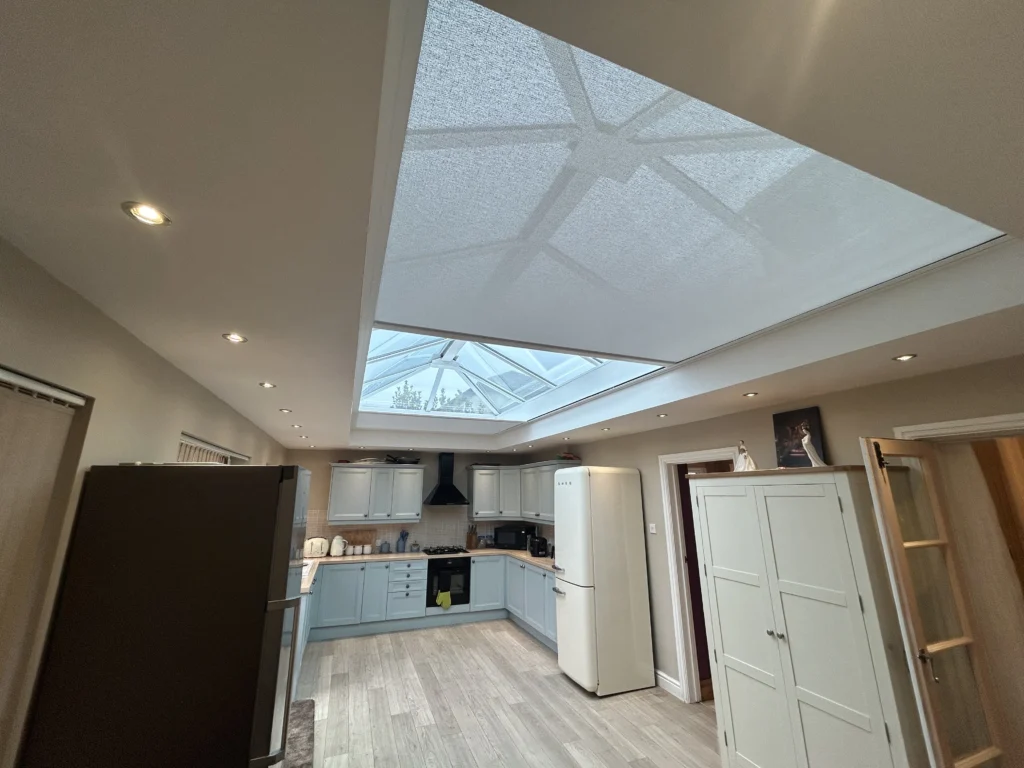
The short answer: an electric roof lantern blind is a motorised blind that runs flat beneath the lantern, held under tension in side channels to keep the fabric as flat as possible. Two recent written quotes show the range: £4,950 including VAT, survey and fitting for a single Athena blind under a 1 m x 1.8 m lantern, and £7,550 on the same basis for a Twin Athena under a 2.5 m x 5.6 m lantern. We fit tensioned, honeycomb, concealed and external systems across Great Britain, except Northern Ireland, and the right one depends mostly on the size of your lantern and how flat you want the fabric to look.
The short version
- Which roof blind suits your lantern: sizes, finish and prices side by side
- Real lanterns and skylights we’ve shaded: Sally, Kathryn, Sarah, Dom and Helen
- What to know before you buy
- Your questions answered, from battery power to self-fit
- What electric roof lantern blinds cost, in more detail
Which roof lantern blind suits your lantern?
Start with two measurements: the width across the opening and the distance the blind has to travel (the projection). Those decide which systems can cover it. Then decide how flat you want the fabric to look when it’s closed, because that’s where cheaper systems and premium ones differ most. If the room overheats badly, also ask whether the sun should be stopped outside the glass instead.
| System | Sizes it covers | How it looks closed | Blind price (incl. VAT) | Choose it when |
|---|---|---|---|---|
| Honeycomb SKY, cord-free | Up to about 1.7 m x 2.5 m | Pleated cells; folds into a stack when open | £1,300 to £1,700 | A small lantern and a modest budget, and you like the pleated look |
| Honeycomb SKY, corded | Up to about 3 m x 5 m per blind; two or three side by side for wider roofs | Pleated, with visible cords across the fabric | £1,100 to £3,200 | Budget matters most and you’re happy to see the cords |
| Venus CTS | Best kept within about 1.5 m x 2.5 m | Flat roller fabric, but some waviness is normal | £1,800 to £2,500 | A smaller lantern, or several small ones, on a tighter budget |
| Athena | Up to about 3 m x 3 m, or 2.5 m x 4.5 m | Smooth and taut: about three times the tension of a CTS blind | £2,850 to £4,500 | You want the cleanest finish and the widest choice of fabrics. Our flagship system. |
| Twin Athena | Two blinds meeting in the middle: about 3 m x 6 m, or 2.5 m x 9 m | As Athena, with a join where the two meet | £4,500 to £8,000 | A long lantern, or you want each half to open separately |
| Hercules XL | Up to about 4 m x 7.5 m as one blind | Heavy-duty tension for very large spans; very wide blinds may need welded joins in the fabric | £4,500 to £11,000 | The lantern is too big for one Athena and you want a single blind |
| Blindspace concealed | Made to suit the blind; a box built into the ceiling, as on Dom’s Athena | Nothing to see when the blind is open | Boxes typically £1,000 to £3,500, plus the blind; try the Blindspace estimator | You’re building now and can plan it in before the ceiling goes up |
| Artemis external | Skylights up to about 5 m wide and 6 m long | A fabric screen on top of the glass, letting soft daylight through | Quoted per roof; one published proposal priced the blind at £5,320 before brackets, sensors, survey and fitting | The room overheats and you want the sun stopped before it reaches the glass |
Blind prices are from our guide to choosing a roof blind. We don’t normally supply roof blinds without our survey and fitting: add £1,900 including VAT for the manufacturing survey and standard installation of up to two systems. Extra blinds, awkward access and preparation work are priced before anything is made. Athena and Twin Athena can run on mains or a solar-charged battery; mains motors need a fused spur fitted by your electrician. All sizes are a first guide, not a manufacturing specification.
Real lanterns and skylights we’ve shaded
- Sally, Cheltenham. A west-facing kitchen with a 4.5 m lantern that got very hot in the afternoons. She wanted one blind, no pleat lines and the sky still visible. We fitted an Athena with our most reflective white fabric. “It makes the room much cooler and we are still keeping all the light.” Read Sally’s story.
- Kathryn. A north-facing extension with a 3.15 m x 4 m lantern that still overheated in summer and drew flies. The other systems she’d looked at couldn’t span it with one blind, so we fitted a Hercules XL. It went in during winter and the room felt warmer straight away. Read Kathryn’s story.
- Sarah. A 30-year-old orangery with two new lanterns, south-facing and too bright. A Twin Athena lets her open one half or both as the sun moves. Read Sarah’s story.
- Dom, Richmond. He called while the builders were laying the joists, just in time to build in a Blindspace box above the dining table. The Athena now disappears into the ceiling when it’s open. Read Dom’s story.
- Helen and Michael, London. A 5 m x 3 m glazed roof made their kitchen unusable on summer days. An Artemis external blind now shades the glass from outside, and “even when it’s fully closed, you still have light coming through.” Read their story.
What to know before you buy
- Most roof blinds sag a little. Fabric is flexible, and lower-tension systems show more ripple when they’re fully closed. That’s normal for the system, not a fault, so we talk it through before you order. Why most roof lantern blinds sag.
- Honeycomb blinds have real pros and cons. They cost less and the dimout fabric helps with winter insulation, but it does little against summer sun, and bigger ones need cords across the fabric. The folded stack shows when open and collects dust, which slowly reduces how much sun the blackout fabric reflects.
- Inside or outside the glass. A reflective blind inside sends part of the sun back out through the glass, but some of its warmth still ends up in the room. An external blind stops the sun before it reaches the glass, so it does the most for a room that overheats. External blinds are out in the weather, though, so they need to retract in strong wind.
- Concealment has to be planned early. A Blindspace box goes in while the roof and ceiling are being built. Once the ceiling is finished, a visible headbox is the usual answer.
- Power needs a plan. Mains motors need a fused spur in or near the lantern, fitted by your electrician. Athena can run on a solar-charged battery instead, which suits a finished room.
- It isn’t quick to make. Lead times are typically 7 to 12 weeks from order.
- Flat openings only. These blinds run in a flat plane beneath a lantern or skylight opening. They aren’t for the sloping, shaped panels of a traditional conservatory roof, and we don’t offer blinds for those.
Your questions answered
How much do electric roof lantern blinds cost?
For one tensioned Athena blind, our published system price is £2,850 to £4,500 including VAT, plus £1,900 for the manufacturing survey and standard fitting of up to two systems. Two recent quotes: £4,950 for a 1 m x 1.8 m lantern (July 2026) and £7,550 for a Twin Athena under a 2.5 m x 5.6 m lantern (June 2026), both including VAT, survey and installation. Honeycomb blinds start lower; very large Hercules XL blinds go higher. See what electric roof lantern blinds cost for what changes the price.
Can I get battery operated roof lantern blinds?
Yes, and they’re wire-free. Athena blinds can run on a battery motor charged by a small solar panel, so no wiring is needed. In our quotes it’s an upgrade of about £650 to £1,200 including VAT, depending on the system. It’s louder than the mains motor (around 70 decibels against 35), and it suits a finished room where there’s no mains power in the lantern.
Do you install roof lantern blinds near me?
We fit across Great Britain, except Northern Ireland, and we’ve installed from North Yorkshire to Richmond and Cheltenham. Most projects start with a video call: send photos and rough sizes, and we’ll tell you which system fits and what it costs. Once you order, we visit to take the final manufacturing measurements.
Can I fit a roof lantern blind myself?
We don’t normally supply our roof blinds for self-fitting. Tensioned systems need the headbox, tensioning parts and side channels aligned to the millimetre or the fabric won’t run true, so every order includes our survey and installation.
Can my roof lantern blinds work with my smart home?
Yes. The motors we use work with a handset or a smartphone app through a hub, and you can add a sun sensor so the blind closes on its own when the sun comes out. Hardwired control for larger home automation systems is also possible. See what works with your smart home.
Which fabric is best for a roof lantern?
It depends on what you want to fix. Choose a highly reflective white or metallised fabric for heat, a screen fabric that keeps some view for glare, or blackout where you want darkness. Sally chose our most reflective white, Sarah a metallised pearl and Kathryn a sunscreen fabric. We send samples so you can see them in your own light. Compare them in blind fabrics compared.
Will a roof blind help in winter too?
It can. Closed in the evening, a roof blind slows the heat leaving through the glass, and Kathryn noticed her room felt warmer straight away after a winter installation. Honeycomb dimout fabric is designed to help with this.
Will it stop flies gathering in the lantern?
Closed, it keeps the room below separate from the lantern space, which is why Kathryn found it stopped flies gathering there. A water-repellent fabric makes the occasional wipe easier.
Do you do blinds for orangery roof lanterns?
Yes. We fit Athena and Twin Athena blinds under orangery lanterns, as Sarah’s orangery shows. The same sizes and prices in the table apply.
Can you fit blinds to a conservatory roof?
Under a roof lantern or flat skylight in a conservatory, yes: the blind runs flat beneath the opening, like any other lantern. We don’t offer blinds for the sloping, shaped panels of a traditional conservatory roof.
Is window film an alternative?
Sometimes. Solar control film on a lantern is cheaper and always in place, but you can’t open it for full sun or close it for blackout. See our skylight and roof lantern films.
Book a free call with Chris and the team. Send a photo of your lantern and its rough size, and we’ll tell you which blind fits, how it will look and what it will cost.
Roof Electric Blind systems
Athena electric roof blind systems
XL Hercules electric roof blind systems
Blindspace Concealed electric roof blinds
External Artemis Electric Roof blinds
Pricing
Learning Centre
How much do electric roof lantern blinds actually cost? (No hidden surprises)
Electric Roof Lantern Blinds. Your Priorities, Preferences & Recommended solution.
How do you get power to electric blinds in a finished room without wrecking the walls?
What happens if my expensive concealed blinds break down inside the ceiling?
Success Stories

Related Products
Electric awnings
Window Film
Home automation & Controls
Electric Zip Blackout blinds
Faq
Electric Roof Blinds
Electric roof blinds transform overhead glazing into a source of comfort rather than compromise. Tensioned fabrics stay tauter, eliminating glare, softening daylight and managing heat in summer and winter. The result is a calmer, more stable indoor environment beneath even the largest roof lanterns or skylights. Concealment can be built in at first fix for a seamless architectural finish, but the real magic is in the performance these systems deliver.
Our electric roof blind systems draw on the same engineering principles as the Hercules XL, Twin Athena, and Athena tensioned solutions, allowing us to shade most architectural roof lanterns up to 4 m wide and 9 m long with perfectly taut fabric. For skylights up to 5m wide and up to 6m long, the Artemis External system provides high‑performance solar protection by stopping heat before it reaches the glass. Together, these systems allow us to cover a wide range of roof glazing sizes with stable, reliable, tensioned shading.
Typically between 7-12 weeks from order, depending on the system and complexity.
Power options vary by system. Many of our electric roof blinds use mains‑powered Somfy motors—available in IO, RTS, or Zigbee—for reliable operation and broad compatibility. For projects requiring deeper integration with home automation, hardwired control options are also available. The Athena and Twin Athena systems additionally offer solar‑powered battery motors, making them ideal for retrofit situations or locations where running power is difficult.
Yes. We offer a wide range of tensioned fabrics, each selected for what you need to achieve. Whether that’s reducing heat gain, softening daylight, improving winter insulation, or achieving dimout or blackout performance.
A significant amount. This is where many roof blind systems fail: they simply don’t generate enough tension to keep the fabric stable overhead. The result is a compromise. No visible cords, but ripples along the zip side channels and waves across the fabric. Our systems are engineered differently. They start at three times the tension of typical roof blind products and rise to 8 to 10 times the tension in the Hercules XL, ensuring the fabric remains tauter, smooth, and secure across large spans without excessive sagging or distortion.
This is what our customer’s expect in their architecturally designed homes.
Explore roof lantern and skylight blinds
Systems
- Athena electric roof blinds: for most roof lanterns, up to about 3 x 3 m
- Hercules XL electric roof blinds: for the largest lanterns, up to 4 x 7.5 m
- Venus CTS electric roof blinds: tensioned blinds for smaller lanterns
- Blindspace concealed roof blinds: boxes that hide the blind in the ceiling
- Artemis external skylight blinds: stop the heat outside the glass
- Skylight and roof lantern window film: the alternative to a blind
Guides